Deployment view
::: formalpara-title Content :::
The deployment view describes:
-
technical infrastructure used to execute your system, with infrastructure elements like geographical locations, environments, computers, processors, channels and net topologies as well as other infrastructure elements and
-
mapping of (software) building blocks to that infrastructure elements.
Often systems are executed in different environments, e.g. development environment, test environment, production environment. In such cases you should document all relevant environments.
Especially document a deployment view if your software is executed as distributed system with more than one computer, processor, server or container or when you design and construct your own hardware processors and chips.
From a software perspective it is sufficient to capture only those elements of an infrastructure that are needed to show a deployment of your building blocks. Hardware architects can go beyond that and describe an infrastructure to any level of detail they need to capture.
::: formalpara-title Motivation :::
Software does not run without hardware. This underlying infrastructure can and will influence a system and/or some cross-cutting concepts. Therefore, there is a need to know the infrastructure.
Maybe a highest level deployment diagram is already contained in section 3.2. as technical context with your own infrastructure as ONE black box. In this section one can zoom into this black box using additional deployment diagrams:
-
UML offers deployment diagrams to express that view. Use it, probably with nested diagrams, when your infrastructure is more complex.
-
When your (hardware) stakeholders prefer other kinds of diagrams rather than a deployment diagram, let them use any kind that is able to show nodes and channels of the infrastructure.
See Deployment View in the arc42 documentation.
Infrastructure Level 1
Describe (usually in a combination of diagrams, tables, and text):
-
distribution of a system to multiple locations, environments, computers, processors, .., as well as physical connections between them
-
important justifications or motivations for this deployment structure
-
quality and/or performance features of this infrastructure
-
mapping of software artifacts to elements of this infrastructure
For multiple environments or alternative deployments please copy and adapt this section of arc42 for all relevant environments.
\
Motivation
: \
Quality and/or Performance Features
: \
Mapping of Building Blocks to Infrastructure
: \
Infrastructure Level 2
Here you can include the internal structure of (some) infrastructure elements from level 1.
Please copy the structure from level 1 for each selected element.
\
\
\
\
...
\
\
Cross-cutting Concepts
::: formalpara-title Content :::
This section describes overall, principal regulations and solution ideas that are relevant in multiple parts (= cross-cutting) of your system. Such concepts are often related to multiple building blocks. They can include many different topics, such as
-
models, especially domain models
-
architecture or design patterns
-
rules for using specific technology
-
principal, often technical decisions of an overarching (= cross-cutting) nature
-
implementation rules
::: formalpara-title Motivation :::
Concepts form the basis for conceptual integrity (consistency, homogeneity) of the architecture. Thus, they are an important contribution to achieve inner qualities of your system.
Some of these concepts cannot be assigned to individual building blocks, e.g. security or safety.
::: formalpara-title Form :::
The form can be varied:
-
concept papers with any kind of structure
-
cross-cutting model excerpts or scenarios using notations of the architecture views
-
sample implementations, especially for technical concepts
-
reference to typical usage of standard frameworks (e.g. using Hibernate for object/relational mapping)
::: formalpara-title Structure :::
A potential (but not mandatory) structure for this section could be:
-
Domain concepts
-
User Experience concepts (UX)
-
Safety and security concepts
-
Architecture and design patterns
-
\"Under-the-hood\"
-
development concepts
-
operational concepts
Note: it might be difficult to assign individual concepts to one specific topic on this list.
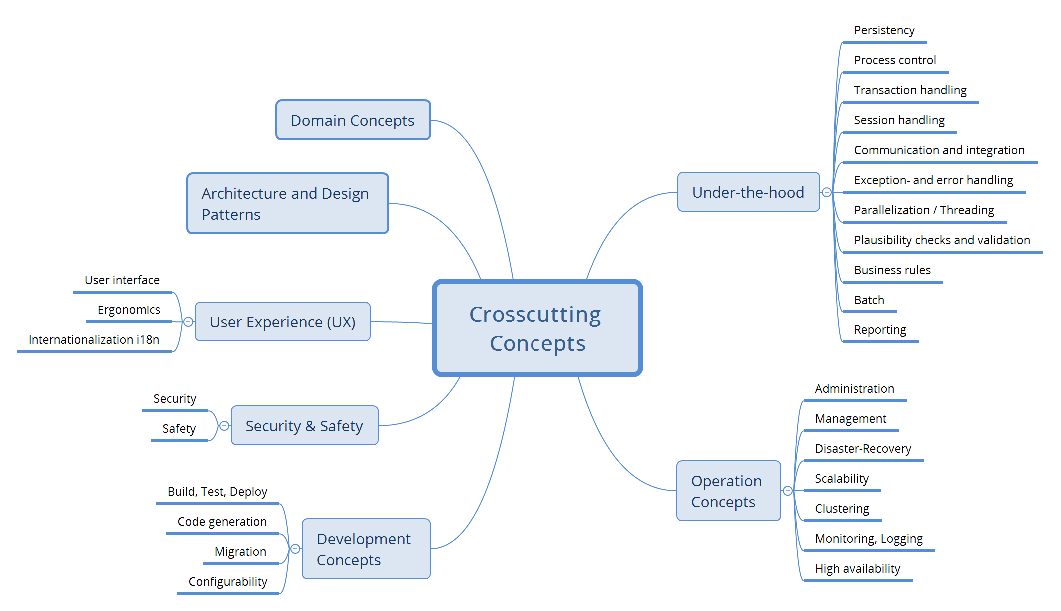
See Concepts in the arc42 documentation.
\
\
\
\
...
\
\